

Over time, knife manufacturers have continually devised new mechanisms to make pocket knives easier to use. In particular, the challenge of opening the blade with one hand sparked the inventive spirit of many engineers and tinkerers. Besides simple solutions like the thumb release, highly sophisticated systems were developed, especially in the area of spring mechanisms.
The term "spring-loading knife" already appears in the sales documents of Solingen manufacturers around the mid-19th century. Some opening mechanisms have recently fallen into disrepute and are even banned in Germany. These include gravity knives, where the blade falls out of the handle by gravity, and OTF (out-of-the-front) spring-loaded knives , whose blades spring out of the front of the handle by spring force.
The following section describes in more detail the most common opening mechanisms of both classic and modern pocket knives.
NAIL CUT 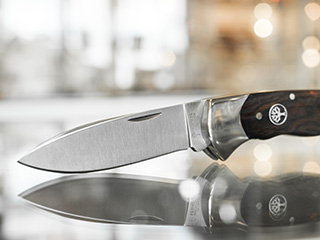
The nail nick , also called a nail groove , is a notch cut into the blade that provides a grip for the thumbnail when opening the knife. This time-tested opening aid remains a standard feature of two-handed knives. On traditional American pocket knives, the nail nick is sometimes a long groove parallel to the spine of the blade, known as a " long pull " in English. If the folded blade offers enough space for the thumb and forefinger to grip the knife in a pincer grip, modern knives often omit the nail nick for aesthetic reasons.
PINBALL 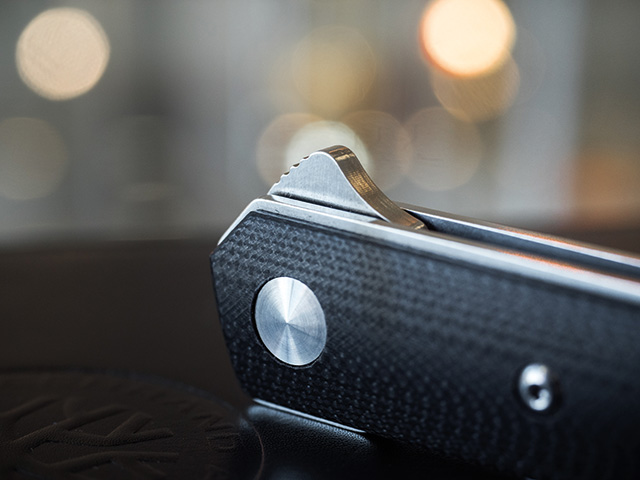
On a flipper pocket knife, the blade tang is shaped so that, when closed, a small lever – commonly called a "nose" – protrudes from the back of the handle. By firmly pulling the lever back with the tip of the index finger, the blade is flung out of the handle. This works better the smoother the blade action, which is why many flipper knives are equipped with a ball-bearing blade. An additional wrist flick can also be helpful. When the blade is open, the flipper nose typically acts as a finger guard. A variation of this opening mechanism is the so-called front flipper , in which a short extension of the blade tang forms the lever, protruding just beyond the end of the handle. A knurled section provides a grip for the thumb or index finger to rotate the blade out of the handle.
THUMBS UP 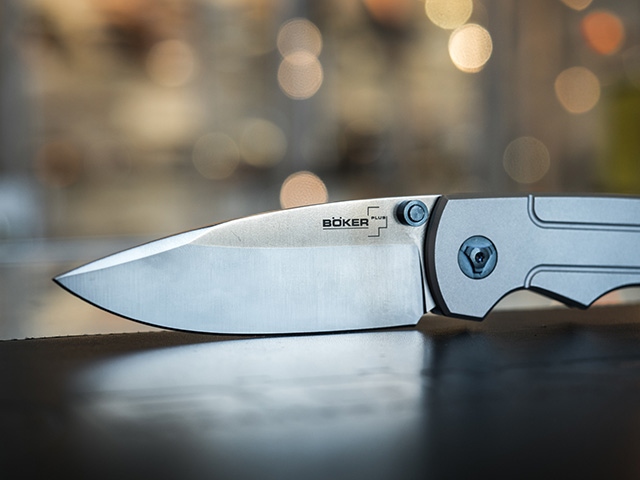
The thumb stud serves as a grip for the tip of the thumb, allowing the blade to be opened with one hand. Some thumb studs are permanently attached, while others can be unscrewed or even moved from the front to the back of the blade. To accommodate left-handed users, some knives are equipped with an ambidextrous thumb stud . Beyond its practical function, the thumb stud is also a design element, its material and shape tailored to the knife's overall aesthetic. Designs range from simple cylindrical shapes to small stepped cones.
BLADE LIFT 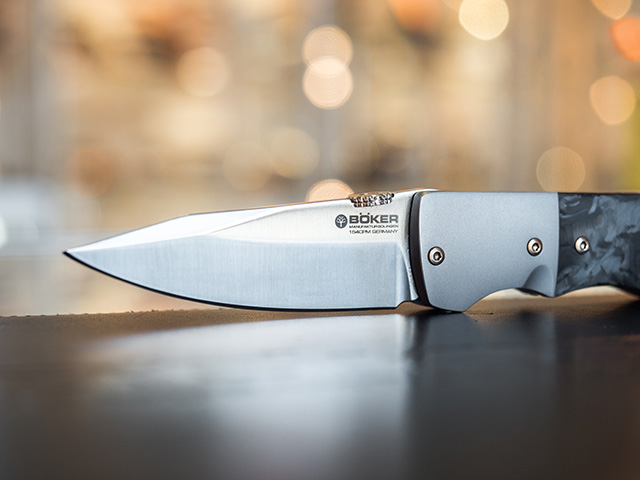
A blade lifter is a small plate or disc screwed onto the spine of the blade. The lateral projection serves the same function as a thumb stud . A slightly more elaborate design involves recessing the blade lifter into a corresponding recess in the blade spine so that both are flush.
THUMB OPEN 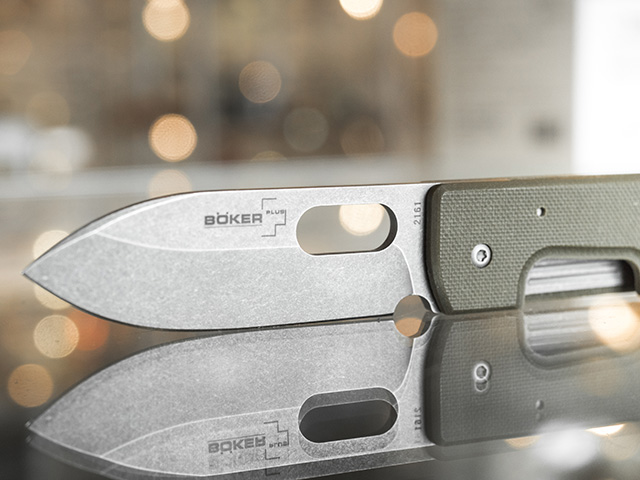
When the American manufacturer Spyderco released its first pocket knife in 1981, a circular hole was featured in the blade. This trademark, now known as the " SpyderHole, " is a simple yet practical opening mechanism: pressing the tip of the thumb against the hole allows the blade to be easily rotated out of the handle. This idea was subsequently adopted and modified by many other manufacturers and knifemakers. The practical blade openings are equally suitable for right- and left-handed users.
SPRINGER/LEVER-LOCK 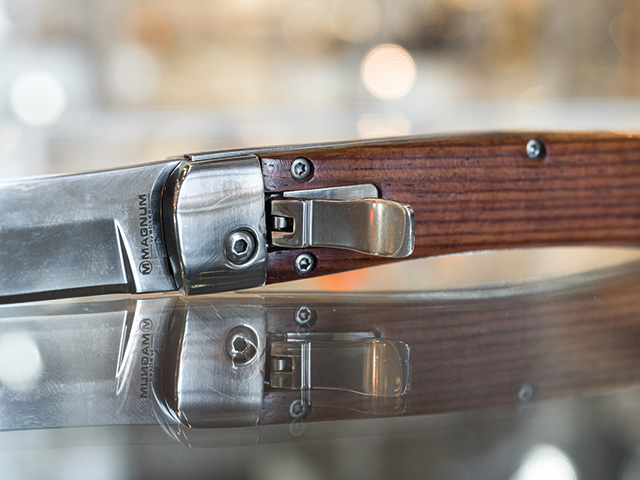
The pocket knives known as "spring knives" feature a spring mechanism whose historical origins are lost in the 19th century and which was apparently never patented, as it was used by several Solingen cutlery manufacturers. The design is based on a leaf spring mounted lengthwise on the handle surface, which holds a locking bolt under tension, blocking the blade tang when closed. Inside the handle is an ejection spring that springs the blade out of the handle laterally as soon as the bolt is lifted, which is done with the help of a small lever. To prevent accidental activation, the lever can be folded forward. The lever thus serves simultaneously as the trigger and the safety mechanism (lever lock).
OTHER SPRING MECHANISMS 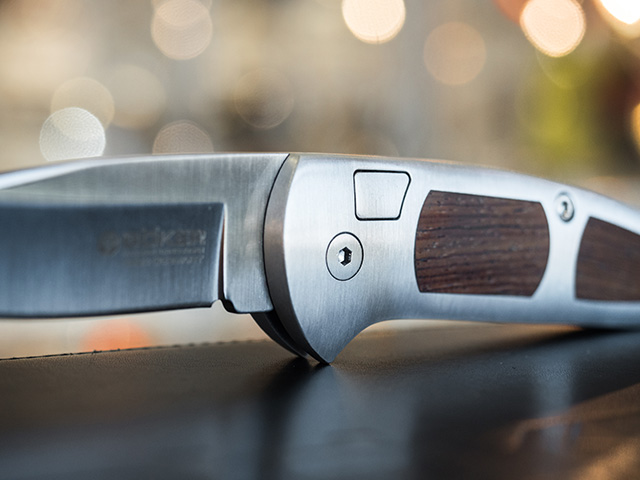
Besides the traditional lever lock, there is an almost overwhelming variety of modern spring mechanisms. Essentially, two types of knives can be distinguished: automatic switchblades and pocket knives with spring-assisted opening mechanisms. The difference lies in the fact that with automatic knives, a push button , lever, or slider triggers the spring mechanism, which then opens the blade automatically. With spring-assisted systems, on the other hand, the blade must be moved manually to a certain opening angle before the spring mechanism engages and catapults the blade into its final position. Our proven Speedlock models are automatic knives : Here, a coil spring wrapped around the blade axis is under tension when the blade is closed. A push button releases the spring, which then causes the blade to spring out of the handle laterally. The Outburst system developed by CRKT is a well-known example of a spring-assisted mechanism.