

Freely adapted from Goethe: Steel is a very special kind of fluid! And this very fluid is the core of every knife. Come along to the "juice bar" and discover what makes a good knife steel.
The knife is the oldest and, according to many experts, the most important tool of humankind. It may seem simple, because what else can you really do with it besides cut? But if you look closely, you realize what a versatile and complex tool it is. Its functionality and optimal use are based on numerous properties.
The cross-section of the blade, also known as blade geometry, has a decisive influence on a knife's cutting ability. A finely honed knife cuts many materials more easily than a relatively coarse knife, which, conversely, is more durable. The blade's contour, in turn, is related to its optimal application. And the handle design significantly determines the possibilities for power transmission, as well as user comfort and safety.
The core of every knife, however, is the blade steel. It determines how sharp a knife can be, how long it retains its edge, how stable the blade is, how well it resists corrosion, and what sharpening tools are needed for resharpening. Currently, well over 100 different types of steel (alloys) are used to manufacture knife blades. Some differ only in nuances, while others are worlds apart in their composition and manufacturing processes.
The simplest – but not necessarily inferior – knife steels consist of iron and small amounts of carbon . The most complex require powder metallurgy production processes and exhibit mixing ratios of iron, carbon , and other alloying elements such as chromium , vanadium, or tungsten that would have been unthinkable in the past, thus enabling new properties.
Depending on the knife type and intended use, different properties are paramount, which can be achieved through a suitable steel alloy and its correct heat treatment – which is more than just the deciding factor. These properties include edge retention , steel toughness , sharpenability , and corrosion resistance.
Edge retention
This refers to how long a knife remains sharp and usable. Key factors are hardness and wear resistance. A hard steel does not bend along the cutting edge as easily under stress as a soft steel . How well the cutting edge resists mechanical abrasion is primarily due to the presence of carbides. These steel constituents are significantly harder than the surrounding hardened structure. Their size – which varies between 0.0005 and 0.04 millimeters depending on the steel alloy – limits the minimum fineness of the steel at which the cutting angle and thickness should be determined. Only when the carbides are firmly anchored in the surrounding steel matrix can they prevent them from breaking out of the structure and perform their function. This is also known as microstability. The carbide structure has a significantly smaller influence on the overall fracture toughness of the blade.
toughness
Steels with high toughness withstand chipping, cracking, or fracture caused by mechanical stresses such as impacts or bending longer than steels with lower toughness. A particularly fine steel microstructure without carbides, or with only a few, ideally evenly distributed and small carbides, as well as a non-exhausted hardness spectrum, are advantageous for high toughness.
Sharpenability
How easily a blade can be sharpened depends largely on the wear resistance of the steel. The more resistant a steel is to abrasion, the longer it naturally takes to sharpen. This also places special demands on the sharpening tools. Some steels can only be sharpened with ceramic or diamond-coated sharpening tools.
Rust resistance
Rust forms when steel oxidizes with oxygen in the presence of water. This corrosion is intensified by salts and acids and does not stop, but rather eats its way deeper into the steel . Initial performance losses occur when the fine cutting edge, which is only fractions of a millimeter wide, is affected by corrosion. Protection against rust is provided by a superficial, very thin oxide layer, which can form during heat treatment , provided the steel contains a sufficient chromium content of approximately 12 to 13 percent. Crucially, the chromium must be dissolved in the base material and not already bound in carbide form.
Practical considerations
For a large cleaver intended for year-long jungle trekking, mechanical durability (toughness) and ease of sharpening should be paramount. A knife that can be easily sharpened with specialized equipment or used to cut abrasive materials like cardboard or sisal rope benefits from high edge retention and durability. Many knife users who work in humid environments value high corrosion resistance.
These four essential properties are not entirely compatible and are not found together in their maximum expression in any known knife steel. However, there are many excellent steels that offer a balanced range of characteristics. Understanding their individual features is interesting, which is why we will break down some of the most popular steels in detail. Despite their differences, they have all proven their worth in use, some for decades.
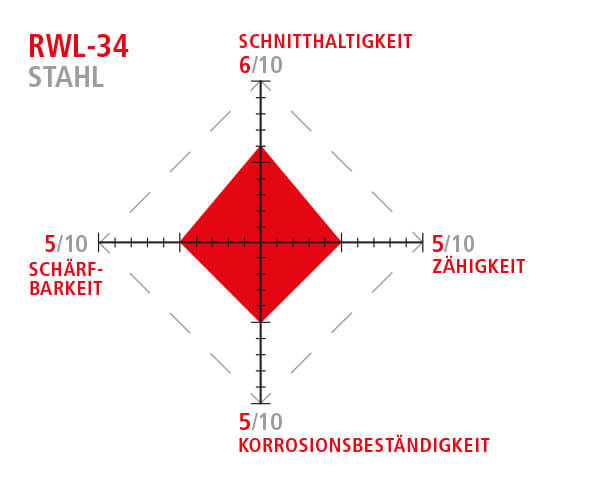 RWL-34
RWL-34 is manufactured by Damasteel in Sweden. The steel's composition is equivalent to the American 154-CM/ CPM-154 . RWL-34 is produced using powder metallurgy, which reduces the carbide size and achieves a more homogeneous distribution. This has a positive effect on sharpenability and toughness. The maximum hardness is 64 HRC , but it is usually hardened to around 60 HRC . RWL stands for Robert Waldorf Loveless, a renowned American knifemaker. Recommended edge angle: 30 degrees and above, depending on the application.
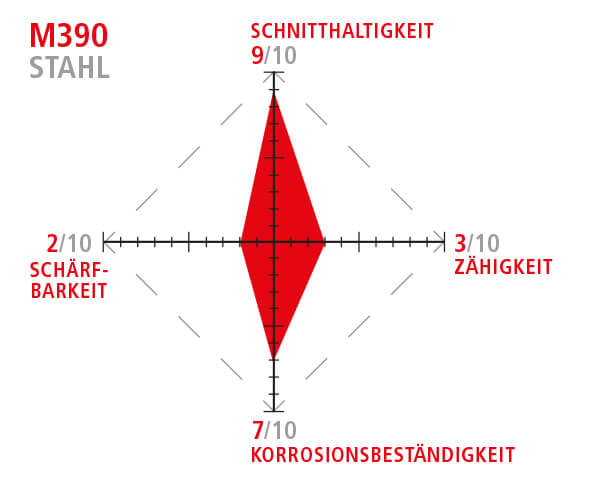 M390
M390
M390 Microclean is a powder-metallurgical martensitic chromium steel manufactured by Böhler (Voestalpine). Industrially, this high- alloy steel is used, for example, in the production of injection molds, which must retain their precise shape even after thousands of uses. In the knife sector, it is primarily used for high-end knives, whose blades, due to its alloy composition with high proportions of carbon , chromium , and vanadium, exhibit extremely high wear resistance and corrosion resistance. It is typically used between 60 and 62 HRC and does not tend to form burrs when sharpened. Recommended cutting angle: from 30 degrees, depending on the application.
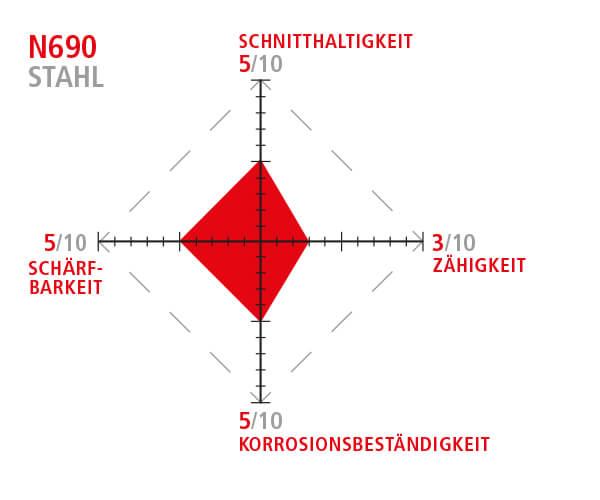 N690
N690
N690 (also known as N690Co) is a corrosion-resistant martensitic chromium steel with additions of cobalt, molybdenum , and vanadium, manufactured by Böhler . Like the Japanese VG-10 , which it resembles, N690 is considered a good all-rounder and is widely used in the upper mid-range, with hardnesses between 58 and 60 HRC . Recommended cutting angle: from 35 degrees, depending on the application.
D2 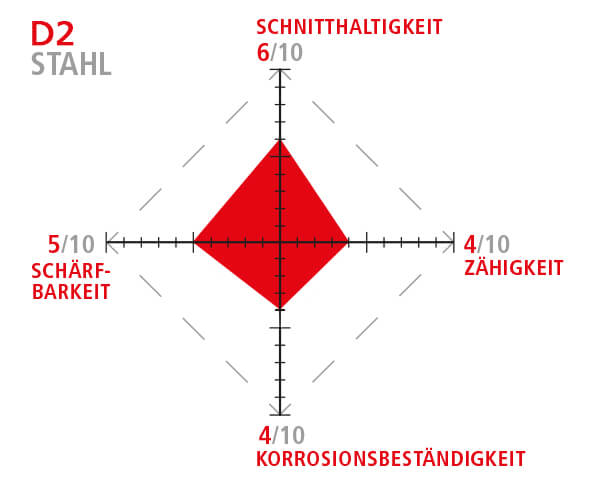
D2 (also known as 1.2379) is a ledeburitic cold work steel. This highly wear-resistant steel was developed for the production of industrial dies and punches, cutting, stamping, and die-cutting tools capable of machining even thick and hard materials. For many years, D2 has also been successfully used in the manufacture of knife blades. Its main alloying elements include approximately 1.55 percent carbon and approximately 11.5 percent chromium . Due to the high number of chromium carbides, the steel is not considered stainless, but rather corrosion-resistant. Because of the high number of large carbides, D2 should be used, at least under heavy-duty conditions, with cutting angles of 40 degrees or more. Typical hardness values range between 59 and 61 HRC .
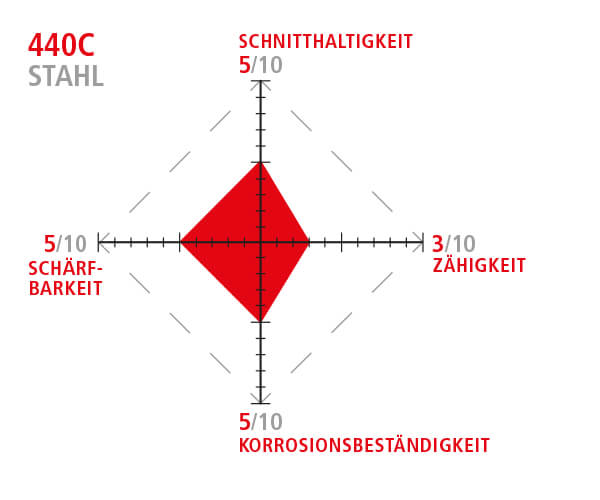 440C
440C
440C (also known as 1.4125 or X105CrMo17) is a chromium-alloyed steel with high hardness, wear resistance, and good corrosion resistance. It was one of the most widely used steels in the premium segment. Nowadays, 440C is often used even for inexpensive knives and is also offered in virtually identical compositions as N695 ( Böhler ) or 4125 (Thyssen-Krupp). It is used at hardnesses around 59/60 HRC . Recommended cutting angle: from 38 degrees, depending on the application.
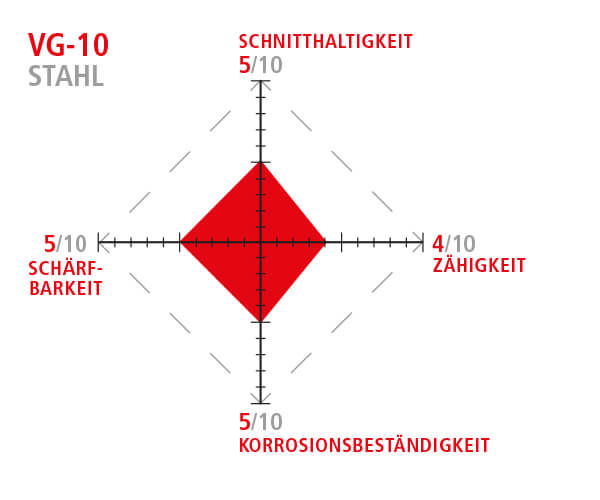 VG-10
VG-10
VG-10 is a conventionally smelted steel from the Japanese steel producer Takefu. It is very popular with Japanese kitchen knife makers and manufacturers like Spyderco, who regularly produce in Japan. This rust-resistant and edge-retaining steel is used at hardnesses between 59 and 62 HRC . Recommended cutting angle: from 30 degrees, depending on the application.
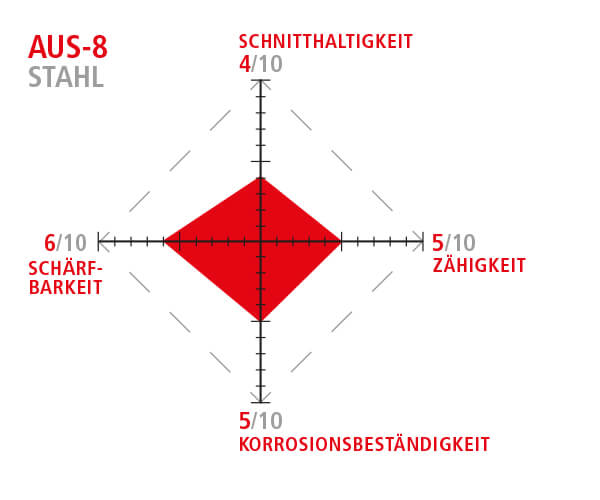 AUS-8 (also AUS-8A)
The Japanese stainless steel from the Japanese steel producer Aichi exhibits a balanced ratio of carbon , chromium , and minor impurities of other elements. AUS-8 has been popular with many Japanese manufacturers for decades. Its heat treatment is correspondingly sophisticated. This "mid-range steel " is used at hardnesses between 56 and 59 HRC . Recommended cutting angle: from 30 degrees, depending on the application.
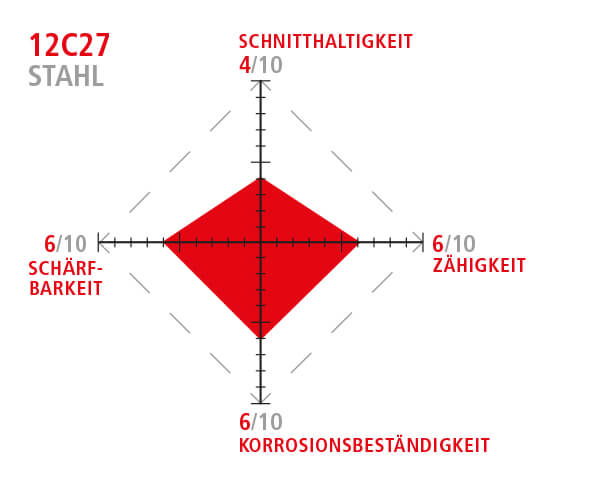 12C27
12C27
The 12C27 steel from the Swedish steel producer Sandvik is a well-balanced steel with excellent corrosion resistance, which is why it is also used for the production of ice skate blades, among other things. Its moderate alloy composition results in a fine-grained steel that takes fine edges, is mechanically robust, and easy to sharpen. It is popular with Scandinavian and French manufacturers. A powder metallurgy variant is produced by Damasteel as PMC27. The typical hardness range is between 56 and 59 HRC . Recommended cutting angle: from 25 degrees, depending on the application.
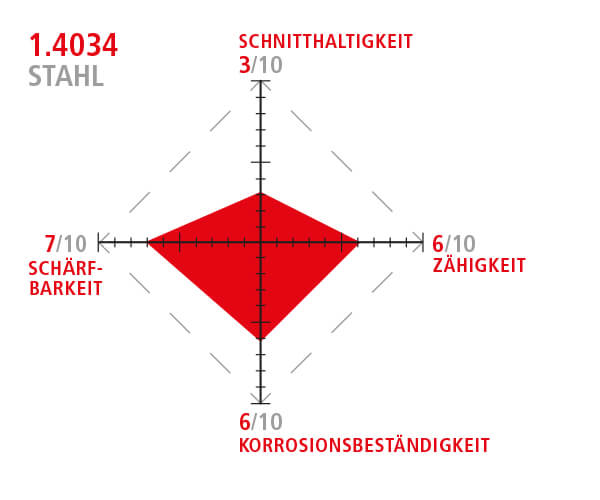 1. 4034
1.4034 (also spelled 4034 ) has a moderate carbon - chromium content and is generally considered a forgiving steel . It offers good corrosion resistance, is easy to sharpen, fine-grained, and mechanically strong. 1.4034 is typically used in applications with hardnesses between 55 and 57 HRC . Recommended cutting angle: from 25 degrees, depending on the application.
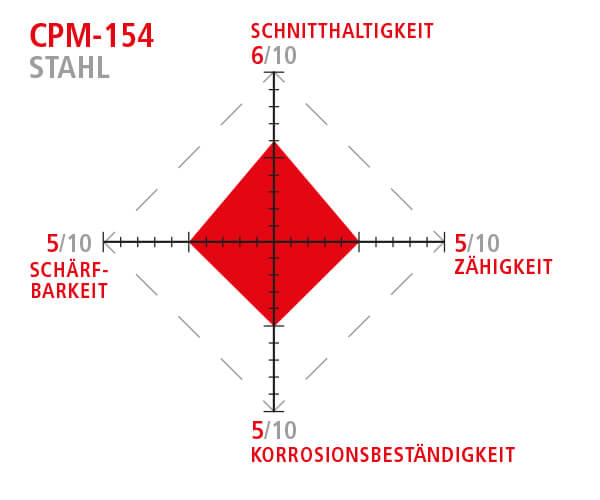 CPM-154
The CPM-154 steel from the US steel manufacturer Crucible was introduced in 2006 and is based on the well-known 154CM steel , but is produced using powder metallurgy. The resulting finer microstructure has a positive effect on toughness and sharpenability. CPM-154 exhibits good wear and corrosion resistance and is frequently used at hardnesses around 59 HRC . Recommended cutting angle: from 30 degrees, depending on the application.
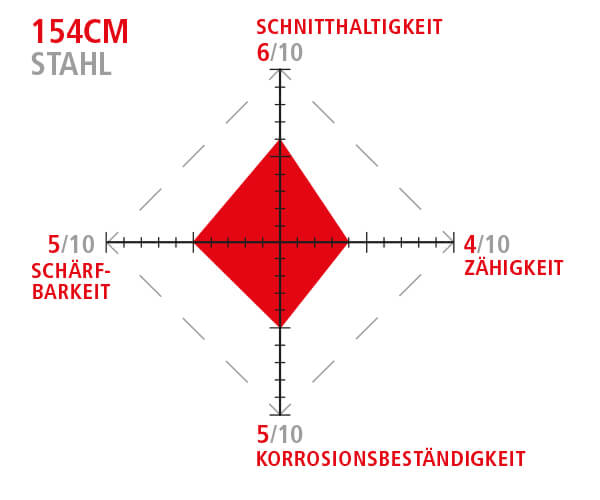 154cm
154cm
In the early 1970s, the steel manufacturer Crucible introduced this alloy to the market. It was intended, for example, for the production of turbine steel engines. The legendary US knifemaker Bob Loveless was one of the first to use 154CM to produce rust-resistant and wear-resistant knife blades. When Crucible temporarily discontinued production, Hitachi manufactured a corresponding copy, the ATS-34 . 154CM was long considered a premium steel and remains popular. It is hardened to 58 to 61 HRC . A powder metallurgy version is also now available. Recommended cutting angle: from 35 degrees, depending on the application.
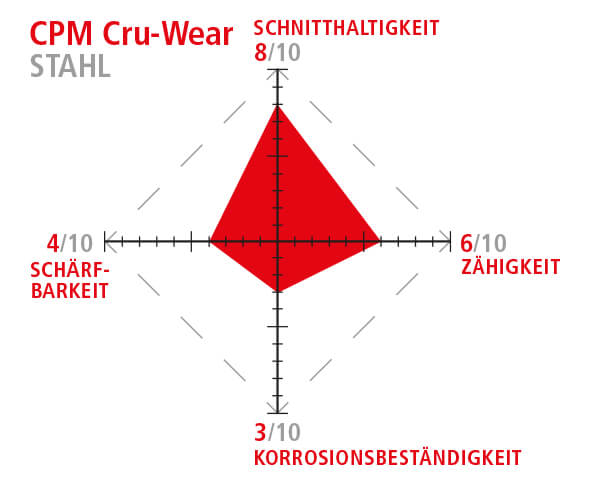 CPM Cru-Wear
CPM Cru-Wear is an air-hardening tool steel produced by Crucible. For knife blades, a hardness between 60 and 65 HRC is targeted. This steel is considered a powder metallurgy upgrade to Cru-Wear and D2 , and its higher vanadium content makes it significantly more wear-resistant. With a chromium content of only 7.5 percent, it is not considered a stainless steel. However, with a little care and careful handling, this is not a problem. We use it, among other things, in one version each of our classic Trio and Quattro hunting pocket knives. Recommended cutting angle: from 30 degrees, depending on the application.
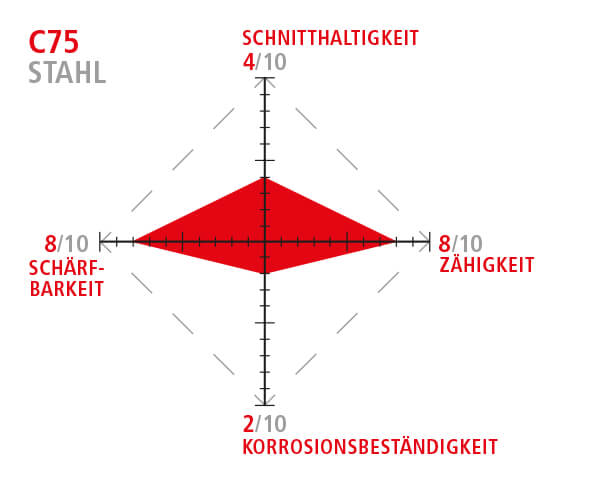 C75
C75
Low- alloy carbon steel is also known as 1.1248, XC75, or 1075. It is a non-stainless steel with a very fine grain, allowing for a correspondingly fine edge. It can be sharpened easily and is mechanically robust, making it a good choice even for larger camping knives. It is typically used with a hardness between 50 and 55 HRC . Carbon steel like this develops a characteristic blue-gray patina through surface oxidation after only a short period of use. This patina protects against rust and is not a defect. Recommended cutting angle: from 20 degrees, depending on the application.
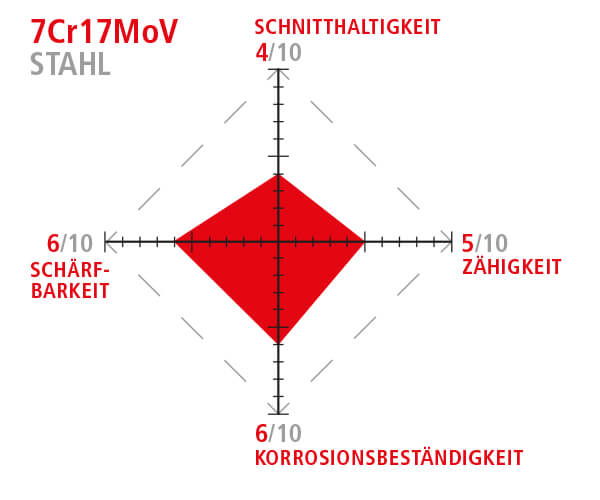 7Cr17MoV
The Chinese steel 7Cr17, as it is more accurately called (since the additions of molybdenum and vanadium are negligible), is an equivalent of 440A steel. This stainless steel exhibits a balanced composition without any particular strengths or weaknesses. Recommended cutting angle: from 30 degrees, depending on the application.